Participatory sensemaking. The AI drafts, your group decides.
Imagine a room where every voice shapes what happens next.
A team, a town, a classroom. One question, phones out, no names attached. Ideas stream in as they’re typed, patterns take shape while everyone watches, and people vote on what rings true. By the end, you’re holding a report the group already endorsed.
In beta · founding facilitators get grandfathered terms
As your participants see it · sample data
Where it fits
One community engagement tool, wherever a group has to think together.
One room with phones out, or scattered across shifts, cities, and time zones — a session can run live in an hour or unfold as a campaign over weeks. Same six steps either way.
Town hall
Live · one eveningA contested question, two hundred residents, no shouting match — every voice lands anonymously.
Strategy offsite
Live · 90 minutesThe debate your team keeps re-having, settled by patterns the group named and voted on itself.
Community consultation
Campaign · async · weeksA question that deepens across a whole community — people answer on their own time, and every conclusion keeps its record.
NGOs & member orgs
Live or campaignThe program reset your volunteers keep hinting at — asked directly, answered anonymously.
Classroom & workshop
Live · one seminarThirty phones in a lecture hall — the discussion the hand-raisers usually own, opened to everyone.
Participatory research
Campaign · multi-roundInquiry Campaigns with session memory and provenance your Institutional Review Board can read.
The core of it
People stand behind what they help build.
Facilitators have always known it: a conclusion a group helped shape is a conclusion the group will act on. That possibility is what IdeaJar is built around.
Most AI tools rush past it — machine-made themes arrive polished, and the group never gets to say what it meant. IdeaJar keeps the drafting fast and the deciding human: AI proposes patterns, your group ratifies, renames, or rejects each one, and the report carries the record. Surveys collect opinions. Brainstorms collect sticky notes. An inquiry builds understanding a group can stand behind.
Provenance ledger
After the Flood · sample- AI drafted
cluster “Transit access” from 14 ideas
- Group renamed
“Getting there without a car” — 11 votes, 2 flagged what was missing
- Group endorsed
final recommendation at 82% — the report shows the rate, not just the claim
How it works
One question, six steps — use as many as the group needs.

01 · SPARK
A culturally-grounded question, cultivated with you
02 · GATHER
The room answers from their phones — 30 seconds, anonymous
03 · EMERGE
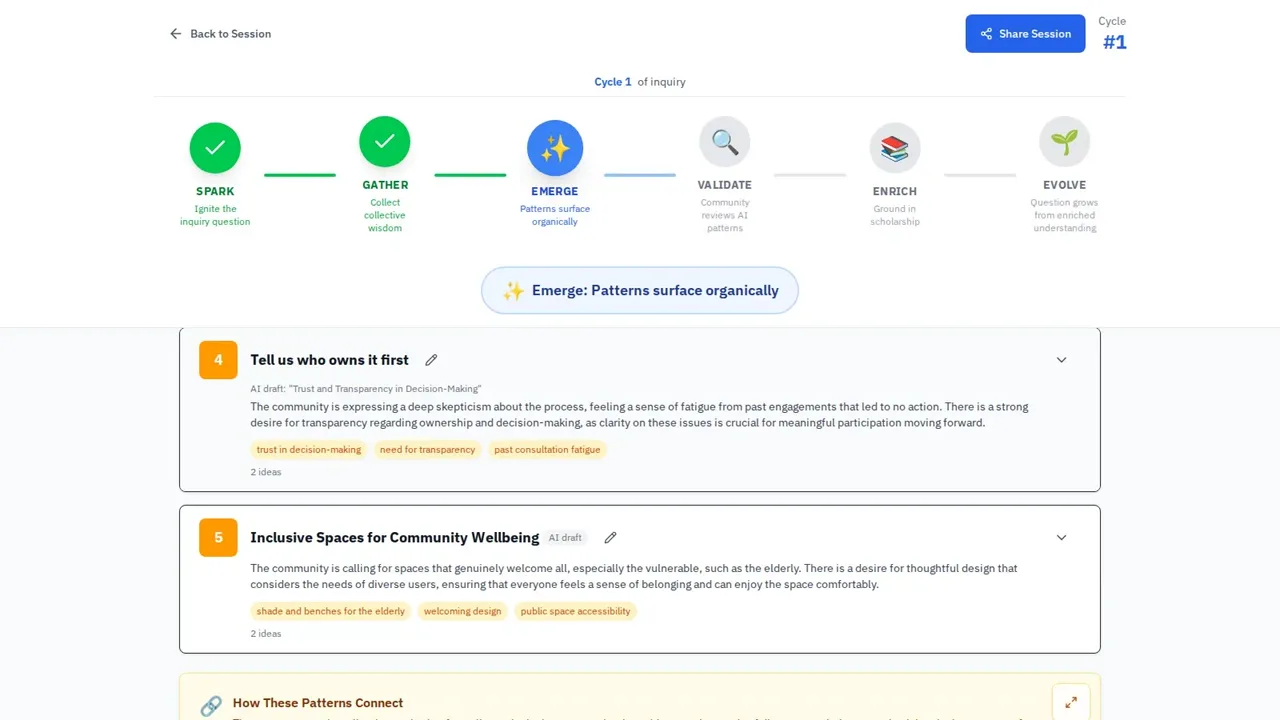
AI drafts the patterns it sees
04 · VALIDATE
The group votes blind, renames, flags what’s missing
05 · ENRICH
Research grounds what emerged — after, never before
06 · EVOLVE
The group chooses the next question. The inquiry deepens
There is no finish line to reach. Plenty of sessions run a single round and stop once the group has named its patterns — that is a complete, useful session. The full arc is there for when the inquiry wants to go deeper: each round’s collective output becomes the raw material for a better next question, and that lineage — the question genealogy — is an artifact no survey tool has.
Watch
The AI drafts, your group decides.
The whole loop, from one question to a report the group endorsed, in under three minutes.
Product footage is the real app running a demo session with sample data. Scenes outside the app and the narration are AI-generated.
The artifact
Watch one question become a lineage.
Every round ends with the group voting on where the inquiry goes next — deepen, expand, bridge, or contrast. The genealogy records each question, who chose its direction, and why. Your report doesn’t just say what the group concluded; it shows how the group got there.
That is the difference between collecting opinions and running an inquiry.
Question genealogy
After the Flood · sampleRound 1
What should we rebuild differently this time?
47 ideas · 6 patterns · group voted deepen
Round 2
What do we protect first when the water comes back?
38 ideas · 5 patterns · group voted bridge
Round 3
Who decides, before the next flood, what gets saved?
synthesis endorsed · report shipped
Why people say the true thing
Honesty needs architecture, not a promise.
The AI never knows who you are
Names and emails are never sent to the AI, and all AI runs server-side — the browser never holds an AI key.
Anonymous means unlinkable
Anonymous participants get server-minted random pseudonyms — never device fingerprints, never emails.
Your words stay yours
Any participant can delete their contributions from a session — no account required, no questions asked.
These are architecture decisions, not policy promises — and no claim appears on this page before its privacy register says it is true.
Why this exists
Most AI is built to replace human judgment. IdeaJar is built on the opposite bet — that AI can amplify collective human agency: the everyday practice of democracy. That is why the AI never owns a conclusion, never knows who anyone is, and why no efficacy claim ships before we have measured it.
For participatory researchers
Multi-round Inquiry Campaigns, with provenance your Institutional Review Board (IRB) can read.
Asynchronous rounds over days or weeks, session memory carrying patterns forward, server-enforced citation rules, and an exportable record of every interpretive decision. The EGI methodology is open — built to be cited, not trademarked.
Ask about the research tierPricing
Free during the beta.
Founding pricing is offered to beta facilitators first, and it stays with you when billing turns on. We are working with a small group of facilitators to get the room right before we charge for it.